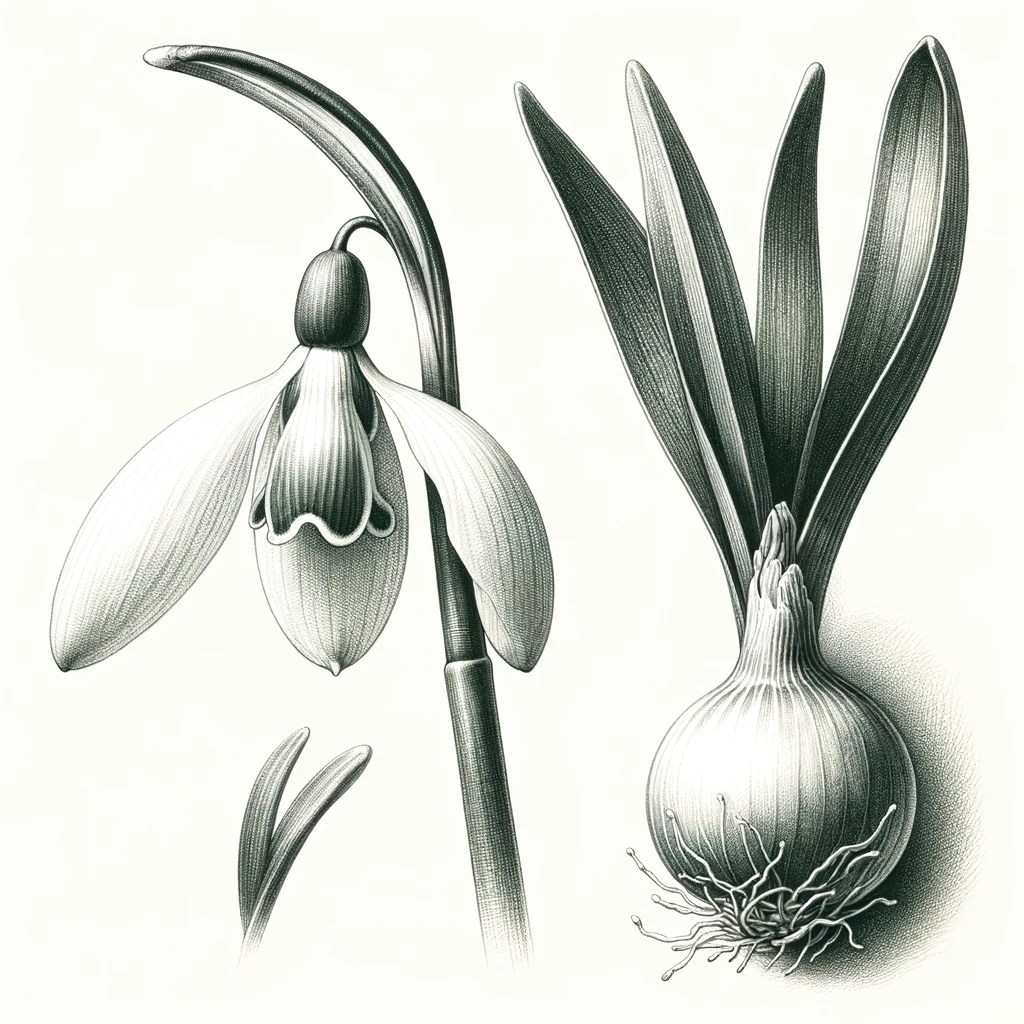
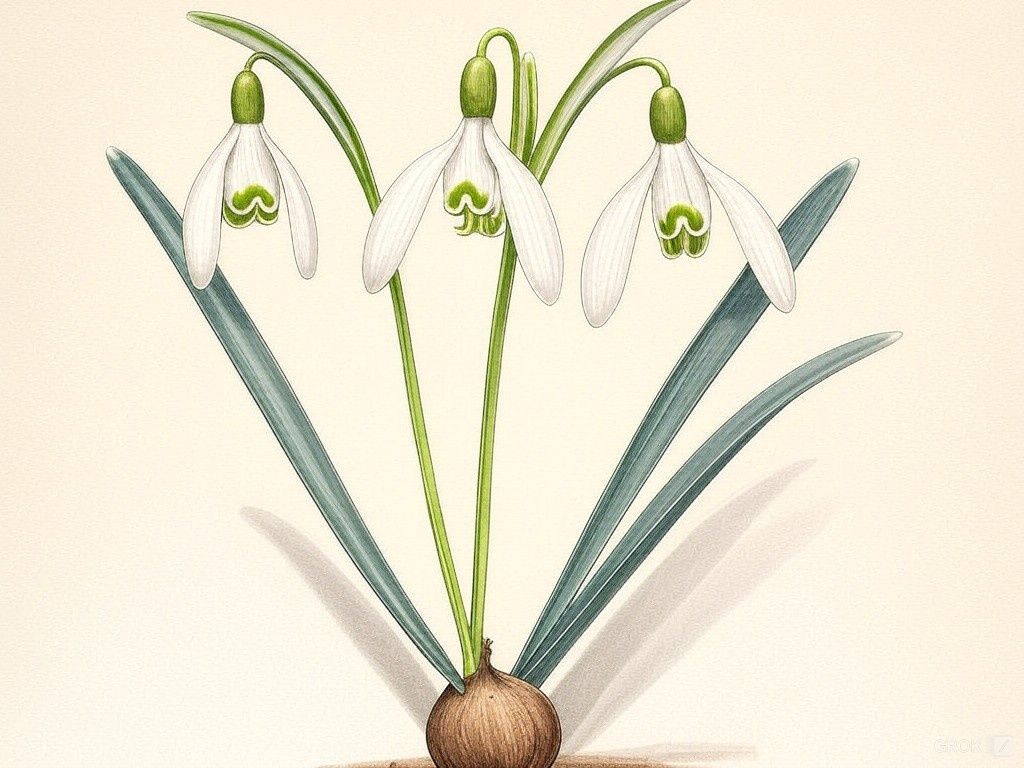
A snowdrop plant is comprised of several distinct structural parts, each playing a crucial role in its growth and reproduction:
1. **Bulb**: The bulb is an underground storage organ, containing the nutrient reserves needed for the plant’s growth and survival during winter. It is from the bulb that the snowdrop emerges in early spring.
2. **Leaves**: Snowdrops typically have two linear leaves that emerge from the base of the plant. These leaves are often a bluish-green color and encase the flowering stem as it begins to grow.
3. **Flowering Stem (Scape)**: This is the stalk that supports the flower. It is usually erect and can vary in length depending on the species.
4. **Flowers**: Snowdrop flowers are pendulous, with three outer white petals that enclose three smaller inner petals, often adorned with green markings. The unique drooping appearance of the flowers is one of the most recognizable features of snowdrops.
5. **Ovary**: The ovary is part of the flower, located at the base of the petals, and contains the ovules. In snowdrops, the ovary is positioned below the rest of the flower parts (inferior ovary).
6. **Stamens**: These are the male reproductive parts of the flower, consisting of a filament and an anther, where pollen is produced.
7. **Pistil**: The pistil is the female reproductive part of the flower, made up of the ovary, style, and stigma. The stigma is where pollen lands and germinates to fertilize the ovules in the ovary.
8. **Seed Capsule**: After fertilization, the flower develops into a seed capsule that contains the seeds. Once mature, the capsule opens to release the seeds, which can then germinate to produce new plants.
Learn more about Snowdrop Essentials
 Snowdrop Garden