
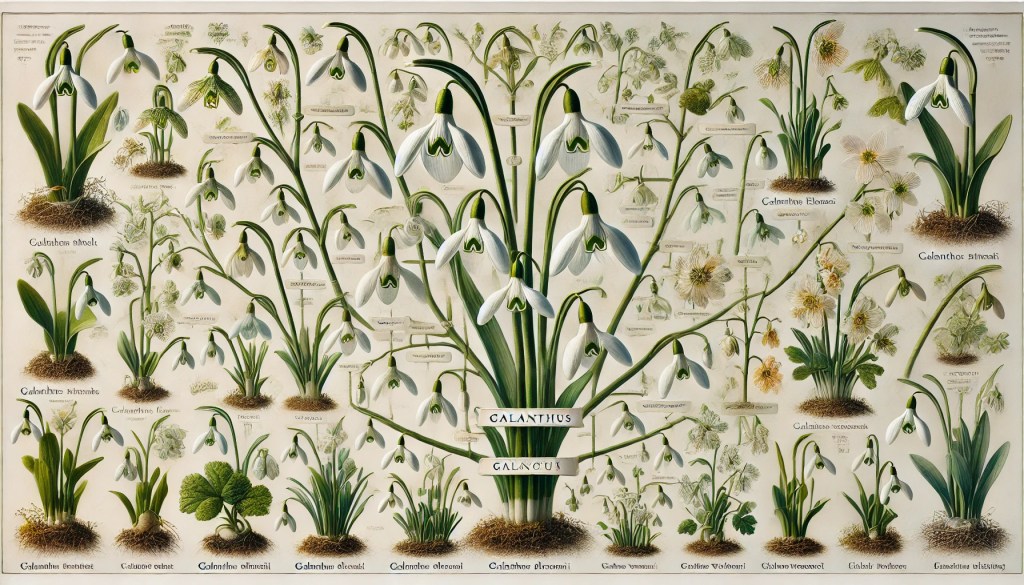
Snowdrops belong to the genus Galanthus, a small group within the Amaryllidaceae family, which encompasses about 20 species and numerous hybrids and cultivars. These species vary significantly in size, flowering time, and petal markings but are all generally characterized by their nodding white flowers, each with three inner petals often marked with green. They are predominantly found across Europe and the Middle East, with each species adapted to its specific habitat, from woodlands to meadows and mountainous regions. The diversity among snowdrop species is a result of their adaptation to different environmental conditions and geographical distributions, leading to a wide range of morphological characteristics.
List of known snowdrop species:
Galanthus nivalis: A widespread species native to Europe, characterized by small, pendulous, white flowers with green markings on the inner tepals. The leaves are linear and glaucous, and it typically flowers in late winter to early spring.
Galanthus elwesii: Native to the Balkans and western Turkey, this species is distinguished by its large flowers, broader, glaucous leaves, and variable green markings on the inner tepals. It flowers early in the season, often in late winter.
Galanthus woronowii: Found in the Caucasus and northeastern Turkey, this species is notable for its glossy, bright green leaves and relatively large flowers with prominent green markings on the inner tepals. It prefers shaded, moist habitats.
Galanthus plicatus: Endemic to Crimea and surrounding regions, this species is defined by its folded (plicate) leaf margins and robust flowers with green markings. It is often cultivated due to its cold tolerance and fragrant blooms.
Galanthus reginae-olgae: A unique species native to the southern Balkans, it is autumn-flowering, with white flowers often appearing before the linear, glaucous leaves. It is adapted to Mediterranean climates with dry summers.
Galanthus ikariae: Endemic to the Aegean Islands, this species has broad, green leaves and large, nodding flowers with green basal markings. It grows in rocky, shaded environments and is closely related to G. woronowii.
Galanthus gracilis: Native to northeastern Turkey, this species is characterized by its arching, glaucous leaves and delicately marked flowers with a green chevron on the inner tepals. It is adapted to rocky and mountainous habitats.
Galanthus cilicicus: Found in southern Turkey, this early-flowering species is notable for its slender leaves and small, pendulous flowers with subtle green markings. It is adapted to rocky, well-drained soils.
Galanthus fosteri: Endemic to Jordan and Syria, this species has narrow, glaucous leaves and flowers with a distinct green mark on the inner tepals. It is well adapted to dry, Mediterranean conditions.
Galanthus transcaucasicus: Native to the Caucasus Mountains, this species is morphologically similar to G. nivalis but has slightly broader leaves and prefers montane forest habitats.
Galanthus alpinus: An alpine species found in the high-altitude regions of the Caucasus, it features compact growth, linear leaves, and small, white flowers with green inner markings. It is adapted to cold environments.
Galanthus platyphyllus: This species, native to the Caucasus, has broad, strap-shaped leaves and large, white flowers with basal green markings. It is distinguished by its wide leaves and robust floral morphology.
Galanthus trojanus: A species native to the region around Troy in Turkey, it has narrow, glaucous leaves and small, pendulous flowers. Its restricted range makes it of conservation interest.
Galanthus angustifolius: Native to the Caucasus, this species is characterized by its narrow, pointed leaves and small flowers with green basal markings. It thrives in forested and montane environments.
Galanthus krasnovii: Found in Georgia and northeastern Turkey, this species features broad leaves with a prominent midrib and large, nodding flowers with distinct green markings on the inner tepals.
Galanthus latifolius: Closely related to G. platyphyllus, this species is endemic to the Caucasus and is characterized by its broad leaves and large flowers with green markings, often found in montane forests.
Galanthus koenenianus: A rare species native to Turkey, it is distinguished by its slender floral morphology and narrow distribution. It is adapted to specific microhabitats in its range.
Galanthus panjutinii: Recently described from the Caucasus, this species is morphologically similar to G. krasnovii but differs in floral proportions and ecological preferences. It is found in montane forests.
Galanthus samothracicus: Endemic to Samothrace Island in Greece, this species has small, delicate flowers with green markings and narrow leaves. Its restricted geographic distribution makes it of taxonomic interest.
Galanthus bursanus: Described in 2020, this species is native to Turkey and is characterized by narrow leaves and small flowers with distinct green markings. It is restricted to limestone habitats, highlighting its ecological specificity.
From a genetic standpoint, snowdrops exhibit a variety of chromosomal counts, which contributes to their diversity and the complexity of their breeding patterns. The basic chromosome number for Galanthus is x=12, but polyploidy (having more than two sets of chromosomes) is common, leading to variations in plant size, vigor, and flower characteristics. This genetic diversity is crucial for the adaptability and survival of snowdrop species in varying climates and conditions. Additionally, snowdrops have been the subject of genetic studies aimed at understanding their unique biological features, such as their natural antifreeze proteins, which allow them to bloom in cold temperatures. These studies not only shed light on the evolutionary adaptations of snowdrops but also have potential applications in agriculture and biotechnology, particularly in developing frost-resistant crops.
Learn more about Snowdrop Essentials
 Snowdrop Garden